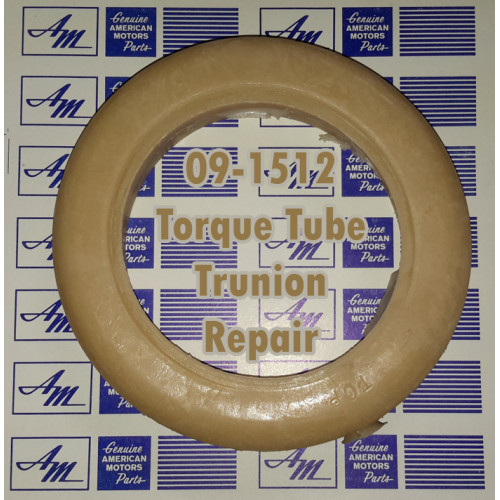
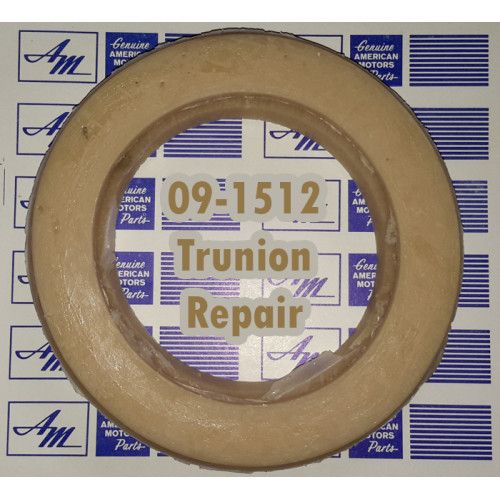
1949-1961 TORQUE TUBE FRONT TRUNNION REPAIR KIT.
THIS IS THE RUBBER CUSHION AT THE FRONT OF THE TORQUE TUBE.
1958-1961 EXCEPT 1958-1959 WITH MANUAL TRANSMISSION.
In a torque tube drive car, the transmission of power is directly transmitted from the rear wheels through the covered drive shaft, (torque tube), through the transmission-engine assembly, which pulls the entire body from the front motor mounts.
To make it easier to understand, take a conventional rear wheel drive car with an open drive shaft, and remove the rear leaf springs and try to drive it. You can’t. The forward thrust power, or torque, needs to push through the rear leaf springs in order to move the car forward or backward. Now do the same with a closed torque tube drive shaft.
The car will still move forward and backward because the power is transmitted through the torque tube to the transmission and the engine block, to which it is attached to and pulls the car body from the front motor mounts.
''Torque tube'' is actually a closed covered drive tube surrounding the driveshaft, transmitting thrust through the torque tube drive stabilizer, to the transmission body, and through the engine block and transmission mounts, rather than through leaf springs or control arms in the rear. The turning drive shaft only delivers power to the rear wheels inside the tube.
The connection of the torque tube to the transmission is made through the Torque Tube Drive Trunnion Stabilizer, in the housing at the transmission. Original stabilizer trunnions go bad because of oil leaks, heat, age, or simply by disconnecting the torque tube for transmission service or u-joint replacement. The rear axle differential and torque tube are a single rigid unit connected at the transmission through the the trunnion stabilizer. A bad stabilizer trunnion always causes unsafe driving.
A defective trunnion stabilizer will cause the rear wheels to flop around, front to back and left to right under the coil springs, flexing at the trunnion. The body simply rests on the rear coil springs and will start to bobble. The car becomes unstable and control varies from poor to very difficult. Instead of being safe and rigid, the drive line behaves like a rubber band. Today, the Lexus LF-A, C5 & C6 Corvette, Porsche 928 and 944, etc. use the torque tube.
It is used in Nash Ambassador 1949-1957, Nash Healey 1951-1954, Hudson Hornet 1955-1957, and various AMC, Nash, & Hudson Ramblers 1952-1962.
THIS IS THE RUBBER CUSHION AT THE FRONT OF THE TORQUE TUBE.
1958-1961 EXCEPT 1958-1959 WITH MANUAL TRANSMISSION.
In a torque tube drive car, the transmission of power is directly transmitted from the rear wheels through the covered drive shaft, (torque tube), through the transmission-engine assembly, which pulls the entire body from the front motor mounts.
To make it easier to understand, take a conventional rear wheel drive car with an open drive shaft, and remove the rear leaf springs and try to drive it. You can’t. The forward thrust power, or torque, needs to push through the rear leaf springs in order to move the car forward or backward. Now do the same with a closed torque tube drive shaft.
The car will still move forward and backward because the power is transmitted through the torque tube to the transmission and the engine block, to which it is attached to and pulls the car body from the front motor mounts.
''Torque tube'' is actually a closed covered drive tube surrounding the driveshaft, transmitting thrust through the torque tube drive stabilizer, to the transmission body, and through the engine block and transmission mounts, rather than through leaf springs or control arms in the rear. The turning drive shaft only delivers power to the rear wheels inside the tube.
The connection of the torque tube to the transmission is made through the Torque Tube Drive Trunnion Stabilizer, in the housing at the transmission. Original stabilizer trunnions go bad because of oil leaks, heat, age, or simply by disconnecting the torque tube for transmission service or u-joint replacement. The rear axle differential and torque tube are a single rigid unit connected at the transmission through the the trunnion stabilizer. A bad stabilizer trunnion always causes unsafe driving.
A defective trunnion stabilizer will cause the rear wheels to flop around, front to back and left to right under the coil springs, flexing at the trunnion. The body simply rests on the rear coil springs and will start to bobble. The car becomes unstable and control varies from poor to very difficult. Instead of being safe and rigid, the drive line behaves like a rubber band. Today, the Lexus LF-A, C5 & C6 Corvette, Porsche 928 and 944, etc. use the torque tube.
It is used in Nash Ambassador 1949-1957, Nash Healey 1951-1954, Hudson Hornet 1955-1957, and various AMC, Nash, & Hudson Ramblers 1952-1962.
Vehicle Compatibility
This product is compatible with the following models and years:
| American Motors | |
|---|---|
| Rambler | 1958, 1959, 1960 |
| Rambler Classic Six | 1961 |
| Nash Motors | |
|---|---|
| 600 CUSTOM | 1949 |
| 600 SPECIAL | 1949 |
| 600 SUPER | 1949 |
| AMBASSADOR 6 | 1942, 1955 |
| AMBASSADOR 6 CUSTOM | 1950, 1951, 1952, 1953, 1954 |
| AMBASSADOR 6 SUPER | 1950, 1951, 1952, 1953, 1954 |
| AMBASSADOR 600 | 1942 |
| AMBASSADOR CUSTOM | 1949 |
| AMBASSADOR SPECIAL | 1949 |
| AMBASSADOR SUPER | 1949 |
| RAMBLER | 1952, 1953, 1954, 1955, 1956, 1957 |
TORQUE TUBE TRUNNION
- Part Number: 09-1512
- Availability: In Stock
-
$279.00